Has Travel Retail Got Promotions Wrong?
Travel retail’s reliance on promotions is putting margin at risk. But used strategically, promotions can be a powerful tool for driving both shopper conversion and profitability. The problem is that across European airports, promotions are too often being treated as a permanent feature of the shelf rather than a targeted commercial lever.
Analysis of Shelftrak data across major European airports points to three recurring issues: promotions are overused, too shallow and poorly matched to their intended objectives.
This analysis focuses on Europe. Promotional dynamics in Asia-Pacific, the Middle East and the Americas differ structurally and require separate consideration.
Promotions Have Become the Default
Promotions are no longer being used selectively to achieve a defined commercial objective. In many airports, they have become a near-permanent fixture.
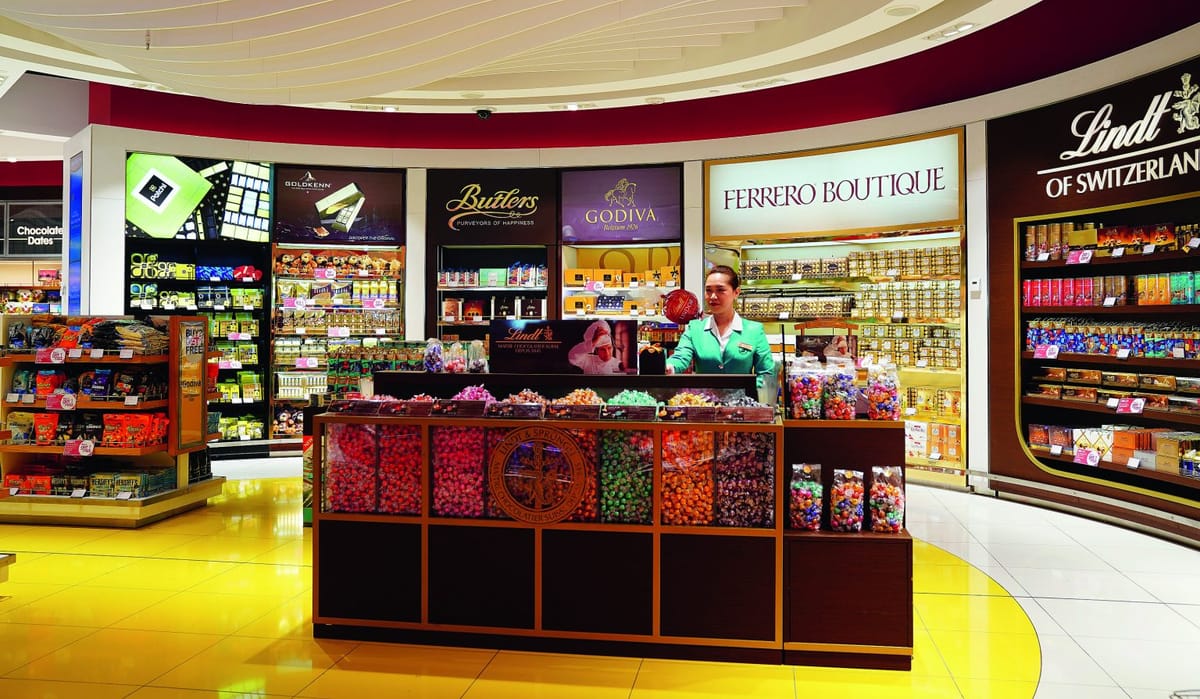
Confectionery promotion rates vary sharply across Shelftrak's European hubs. In several — concentrated in Southern and Central Europe — promotions cover nearly half the shelf, roughly double the network norm, a scale that starts to look less like a targeted campaign and more like the everyday shelf price.
At this level of promotional saturation, the offer itself risks losing impact. When a large proportion of the category is permanently discounted, promotions become less distinctive and shoppers can become conditioned to wait for the next deal rather than purchase at full price.
There is also a wider brand and category consideration for duty free. The sector trades heavily on quality, exclusivity and value. Excessive promotional activity can begin to undermine those associations, potentially encouraging shoppers to question why a product needs to be discounted so frequently.
Promotions should therefore reinforce the value proposition of duty free, rather than become the proposition themselves.
The Shallow Discount Trap
The second issue is discount depth.
A promotion must provide a compelling enough incentive to change shopper behaviour. Shallow discounts struggle more to shift shopper behaviour in any meaningful way, yet many airports continue to lean heavily on exactly this kind of modest markdown.
In Northern Europe, one major hub's discounts are so shallow they barely register with shoppers. The UK tells a similar story: at two of its largest airports, promotions cluster overwhelmingly in that same low-impact band.
This raises a fundamental question: if the discount is not sufficiently compelling to change behaviour, is the retailer simply giving away margin to shoppers who would have purchased anyway?
Impact tends to strengthen meaningfully from around 30% — the point at which the offer becomes compelling enough to shift genuine purchase behaviour, rather than simply rewarding shoppers who would have bought anyway.
Increasing promotional depth selectively may offer greater commercial value than maintaining a high volume of low-impact offers.
One Mechanic Cannot Deliver Every Objective
The third issue lies in how promotions are constructed.
Different promotional mechanics serve different purposes, yet travel retail frequently relies on a single mechanic across a category or airport, with insufficient consideration of the objective behind the promotion.
That objective should come first. Is the retailer trying to recruit new shoppers, drive conversion, encourage trade-up or increase basket size? The answer should determine the mechanic, while also providing a clear measure of whether the promotion has succeeded.
Percentage discounts, single-item discounts and multi-buy offers each have a role to play. Multi-buys reward existing shoppers by increasing basket size, encouraging them to buy more volume than they otherwise would. Percentage discounts can be particularly effective in attracting and converting shoppers who may otherwise not purchase, since they lower the barrier to trying something new. Single-item discounts encourage shoppers to purchase products they may otherwise be hesitant to buy.
A retailer relying on one mechanic therefore limits the range of commercial outcomes it can achieve.
This is trap many airports have fallen into. At one major UK airport, for example, every single promoted product relies on the same single-item discount mechanic, with no variation at all. Elsewhere, the pattern just shifts direction: a major Southern European hub leans almost entirely on percentage discounts, while a leading Nordic airport goes all-in on multi-buys instead.
The consequence is that the promotional strategy becomes constrained by the mechanic rather than driven by the objective.
Every Promotion Should Have a Job
These three challenges — overuse, insufficient depth and poor mechanic selection — have a common cause: promotions are too often being treated as a permanent feature of the retail environment rather than as a strategic commercial tool.
Frequent promotions are not necessarily a problem. The issue is whether each promotion has a clear purpose and whether the retailer is achieving it.
For travel retailers, the opportunity is to move away from asking simply "What should we promote?" and instead ask "What are we trying to achieve?"
The objective should determine the mechanic. The mechanic should be supported by an appropriate level of discount. And the result should be measured against the original objective.
That approach turns promotion from a default behaviour into a commercial decision.
Get it wrong, and frequent promotional activity can begin to look like desperation — training shoppers to wait for the next deal, eroding full-price sales and potentially weakening perceptions of quality.
Get it right, and the same frequency can look very different: not discounting for discounting’s sake, but a deliberate strategy to recruit shoppers, increase spend, drive volume or strengthen conversion.
For European travel retail, the opportunity is not necessarily to promote less. It is to promote with greater intent.
Every promotion should have a job. The retailer’s task is to define that job first, then select the depth and mechanic most likely to deliver it.
Shelftrak recommendations of an effective travel retail promotion
- Define the objective first — recruitment, conversion, volume, trade-up or basket growth.
- Choose the mechanic second — don't let the available mechanic dictate the objective.
- Make the discount meaningful — particularly where the aim is to change shopper behaviour; the data points towards 30%+ as an important benchmark.
- Measure incremental value, not just sales — a promotion that generates sales but simply replaces full-price purchases may destroy value.
- Promote with intent, not habit — frequency is not inherently wrong; unstrategic frequency is