The hidden cost of poor execution: Shelftrak to spotlight lost revenue at Cannes

TFWA Cannes is one of the most important events in the travel retail calendar: a showcase for new product launches, activations and partnerships that help drive the industry forward.
But the focus on what is new and next can create a commercial blind spot. While brands invest significant time and resources in innovation, the fundamentals of in-store execution can be overlooked — even though they ultimately determine whether that investment delivers.
The most innovative product, activation or partnership can only reach its full potential if the basics are right. Is pricing competitive against the relevant set? Are must-stock products consistently available? Are hero SKUs receiving the space, visibility and facings they deserve?
These may appear to be simple questions. In practice, they can be among the most commercially important.
As brands prepare to showcase their new launches at Cannes, Shelftrak is encouraging the industry to examine those fundamentals — and quantify what happens when they are not executed effectively.
During Cannes, Shelftrak will be asking brands and retailers one simple question:
How much is inconsistent store execution actually costing your business?
Brands invest heavily in innovations and activations with genuine commercial potential. Yet some of that potential is routinely lost at the shelf — not because the strategy is wrong or the idea is weak, but because execution falls short.
Shelftrak identifies these execution gaps, translates them into quantified commercial opportunities and provides teams with clear actions to capture the value being missed.
Analysis of April 2026 data from a major spirits brand demonstrates the scale of the opportunity. In a single airport store, Shelftrak identified $800k in commercial opportunity in lost revenue and margin.
From execution data to commercial value
Shelftrak delivers this analysis through its Perfect Store approach.
Perfect Store combines SKU-level execution data with client sales and margin data to calculate the financial impact of underperformance and quantify the value available from addressing it.
In practice, Shelftrak:
- Tracks execution at SKU and store level.
- Benchmarks performance against agreed standards, competitors and comparable stores.
- Identifies gaps across space, price, promotion and distribution.
- Applies sales and margin data to quantify the financial impact.
- Prioritises the highest-value opportunities by store
- Creates clear actions for brand and retailer teams.
- Can track and measure the impact of actions implemented.
Perfect Store does more than identify execution gaps. It provides the foundation for an ongoing commercial growth programme — turning insight into action and measuring whether those actions deliver.
Where the spotlight falls at Cannes
Shelftrak measures execution across the core commercial metrics that determine success in store.
Space productivity
Shelf space should reflect commercial contribution and growth potential, rather than simply historical allocations or legacy negotiations.
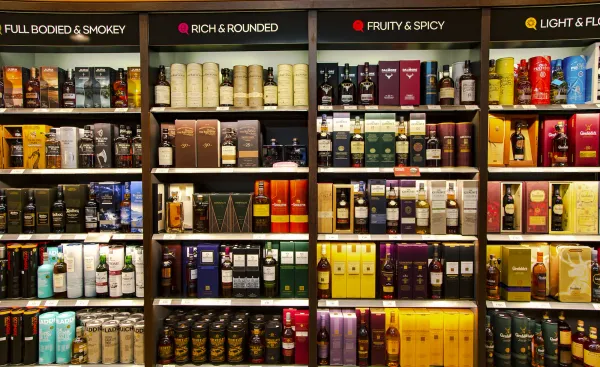
Shelftrak assesses this by comparing share of shelf space with client sales or market share. This reveals where brands may be under-spaced relative to their sales/market share, allowing clients to reallocate brand space to higher-velocity SKUs.
Price competitiveness
In travel retail, price is fundamental to delivering value to the traveller. Shoppers expect the channel to offer a compelling reason to buy, whether through a genuine price advantage, an exclusive product, a distinctive format or a strong promotional offer. Getting that value equation right is critical to converting interest into purchase.
Price positioning therefore needs to be actively managed. It is not simply about being cheaper, it is about ensuring the price reflects the value being offered and remains credible against relevant markets, competitors and alternative purchase occasions. When that balance is wrong, brands risk weakening the traveller proposition and leaving sales on the table.
Shelftrak continuously tracks price positioning to identify where the value proposition is being compromised in the category and where corrective action can unlock incremental growth and margin expansion.
Promotional effectiveness
Promotions should generate incremental sales. In practice, excessive discounting or poorly targeted promotional activity can dilute margin and not deliver a return on investment.
Shelftrak identifies over-promotion, excessive discount depth and inconsistent promotional mechanics, and can benchmark the promotional strategy against the category norms.
Must-stock distribution
When hero or must-stock SKUs are absent from the shelf, the commercial impact is immediate.
Shelftrak analyses priority-SKU distribution store by store, quantifies the value being lost through gaps in availability, and works with brands to develop clear listing and corrective-action plans.
From Strategy to Shelf: Turning Investment into Commercial Impact
This gives commercial teams both a diagnosis and a route to action, helping ensure availability issues are addressed rather than simply reported.
Innovation will always be central to travel retail's growth. But innovation only creates value when it is translated effectively in store.
For brands heading to Cannes, the opportunity extends beyond deciding what to launch next. It is also a chance to ensure that existing investments, agreements and activations are being executed as intended and delivering their full commercial potential at the shelf.
Ultimately, the value of any strategy is determined by its execution. The shelf is where investment translates into performance — and where commercial impact becomes measurable. That is what Shelftrak can deliver.