The Travel Retail Shopper Is Changing. Is the Shelf Keeping Up?
The travel retail shopper is changing. As purchasing power and expectations shift, the shelf must follow.

The travel retail shopper is changing.
There is no longer a single "universal traveller". And with that, the idea of a universal airport assortment is becoming increasingly outdated.
Travel retail is simultaneously experiencing two significant shopper shifts: purchasing power is being redistributed across a more geographically diverse traveller base, while younger consumers are changing what they expect from travel retail.
The demographic shift: the rise of the Indian international traveller
One of the most significant demographic changes within global travel has been the rapid growth of India's outbound international traveller population. Projections estimate 40–44 million trips will be made by Indian travellers in 2026, up from 37–39 million in 2025. This represents an enormous increase over the past decade: in 2016, 21.9 million Indians travelled abroad.
The growth is structural. It is being fuelled by a rapidly expanding middle class, improved international connectivity, rising disposable incomes and increased demand for international business and leisure travel.
The rise of the Indian international traveller is therefore becoming an increasingly important force in global travel retail — significant enough that airports, brands and retailers are adapting their strategies accordingly.
Indian travellers are an increasingly valuable duty-free audience, with categories including luxury, beauty and electronics aligning particularly well with their value-seeking, gifting and premiumisation motivations. Dubai Duty Free has repeatedly identified Indian travellers as one of its important customer groups, while m1nd-set research has highlighted strong conversion and interest across categories including beauty, luxury and electronics. Gifting is another important behaviour, with the potential to push spend towards higher-value SKUs.
This growing influence is already encouraging retailers and brands to think differently about assortment, service and communication. From Indian whisky and premium fragrance to beauty assortments, language and culturally relevant customer service, the question becomes whether the retail offer accurately reflects the passengers now moving through the airport.
And this growth story extends beyond India. Across Southeast Asia, expanding middle classes, rising disposable incomes and greater air connectivity are creating new populations of international travellers. Markets including the Philippines and Malaysia illustrate the broader shift: international purchasing power is becoming more geographically diverse.

The Chinese traveller is changing too
For more than a decade, Chinese travellers have been one of the most consequential forces in global tourism — and, by spending, China remains the world's largest outbound tourism market.
UN Tourism reports that Chinese international tourism expenditure rose 30% in 2024 to $251 billion, around 3% above its pre-pandemic level, making China the world's largest source market by tourism expenditure.
It isn't simply the number of Chinese travellers that makes this market significant. It's their purchasing power.
But their shopping habits are changing.
Increasingly, there is a disconnect between traffic and conversion. Hainan, for example, welcomed more visitors in 2024, yet duty-free spending fell 29.3% and duty-free shopper numbers declined 15.9%.
One of the key changes is growing price transparency. China Trading Desk reported that 98% of surveyed Chinese travellers compare duty-free prices online before buying. Increasingly, the shopping journey starts before travellers arrive at the airport. The airport can therefore become the final conversion point rather than the beginning of product discovery.
This sits within a broader rise in value consciousness. Oliver Wyman's 2024 research found that 57% of surveyed affluent Chinese consumers planned to reduce spending on shopping during international trips. Its 2025 research also pointed to a polarisation in luxury consumption, with casual luxury shoppers reducing expenditure while core luxury shoppers remained much more resilient.
These changing shopping patterns tell an important story. Chinese travellers are still shopping. But shopping has to compete harder for their attention and money.
This is where the shelf comes in.
The shelf needs to become more responsive, more relevant and better at converting an already-informed shopper. Crucially, the products shoppers are actually looking for need to be available, while value has to be immediately visible.
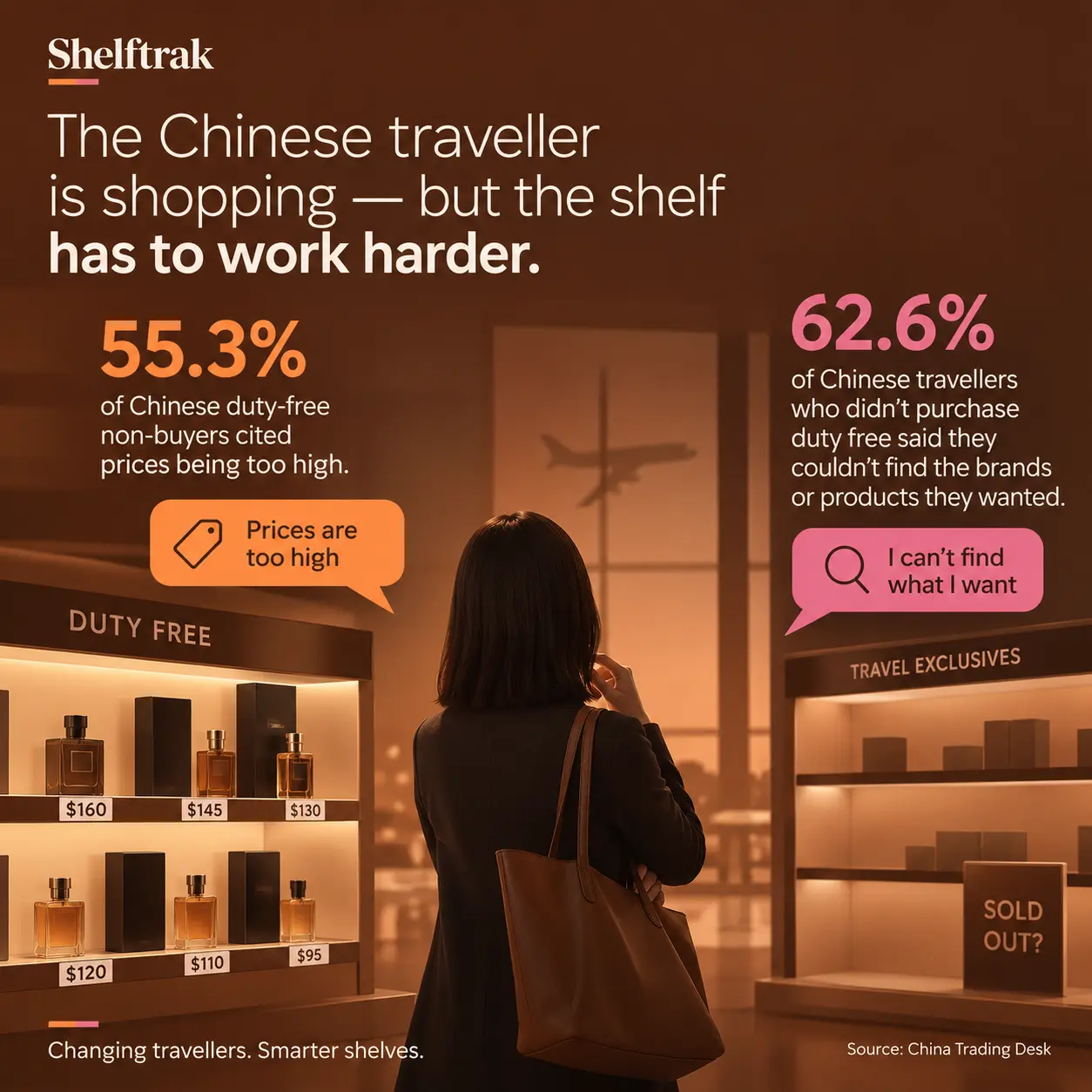
China Trading Desk found that 55.3% of surveyed Chinese duty-free non-buyers cited prices being too high. If travellers are comparing prices online, airport retailers need credible price positioning, exclusives, gifts-with-purchase or another tangible reason to buy.
But price isn't the only issue. Even more strikingly, 62.6% of surveyed Chinese travellers who didn't purchase duty free said they couldn't find the brands or products they wanted.
That makes assortment accuracy critical.
The Chinese traveller hasn't become less important to travel retail. They have become harder to satisfy. Traffic alone is no longer enough. If the traveller arrives knowing what they want, knowing what it costs elsewhere and with more experiences competing for their spending, the shelf has to work considerably harder to convert them.
The growth of the younger traveller
The next change isn't about nationality, but age. As Gen Z and younger Millennials become a more important part of the international traveller mix, they are bringing a different set of expectations into the airport.
For younger travellers, the product alone may no longer be enough. Experience increasingly forms part of what they consider valuable. McKinsey found that 52% of Gen Z travellers say they splurge on experiences, compared with just 29% of Baby Boomers. More strikingly, Gen Z travellers would look to save on flights, transport, shopping and food before cutting their spending on experiences.
The same pattern is visible in luxury. EY's Luxury Client Index found 80% of Gen Z luxury consumers were willing to pay for experiences, compared with 56% of Gen X and 44% of Baby Boomers. Its latest research also finds younger consumers relatively more interested in niche labels, while 75% of aspirational luxury consumers say they are likely to repurchase from brands offering unique complimentary experiences.
That potentially changes what the airport store needs to do.
For decades, one of duty free's central propositions was access: a desirable product at an attractive price. But younger consumers can now access an extraordinary range of brands and products from their phones. The physical airport store therefore needs to offer something digital retail cannot replicate as easily: participation.
Not simply seeing a bottle on a shelf, but tasting it. Not simply encountering a beauty brand, but trying something new. Personalisation, games, digital interactions, pop-ups and collaborations can turn shopping into something the traveller does, rather than simply somewhere they buy.
Airport-specific research supports this. Airport Dimensions found that younger travellers are more attracted to experiential airport propositions, with 57% of Millennials and 56% of Gen Z wanting more walk-through duty-free concepts.
And travel retail is already responding.
At Antalya Airport, the M&M's Experience combines personalised gifts and location-specific packaging with gamification and digital interaction, alongside limited-edition collaborations aimed particularly at Millennials and Gen Z.
At Larnaca Airport, Cyprus Duty Free's Hot Shop has been explicitly designed to engage Gen Z travellers, bringing together 16 emerging and local beauty brands across K-Beauty, skincare, haircare and mists rather than organising the space conventionally around established brands.
Changi provides another model. Its Changi 1st programme uses airport-exclusive launches and temporary activations to give passengers access to products and experiences they cannot necessarily encounter elsewhere; in 2025 alone, it hosted 20 such outposts.
This also points to a broader shift in what exclusivity can mean in travel retail. Traditionally, exclusivity has centred on the product: a limited-edition bottle, airport-only format or something unavailable in the domestic market. For younger travellers, the opportunity is to make the experience exclusive too — through a tasting, personalisation, collaboration or immersive activation that cannot simply be replicated online.
The airport's advantage, therefore, isn't only offering something travellers cannot buy elsewhere. Increasingly, it may be offering something they cannot experience elsewhere. For the younger shopper, the most compelling travel retail exclusive may not just be something to own, but something to take part in.
If the shopper changes, the shelf has to change too
Taken individually, these trends require different responses. The growth of Indian and Southeast Asian travellers demands greater cultural and geographic relevance. The changing Chinese traveller requires better assortment accuracy and a more compelling value proposition. Younger travellers demand greater discovery, participation and experience.
But collectively, they point towards the same problem.
The shopper is changing faster than the shelf.
If passenger demographics are becoming more diverse, a universal assortment becomes harder to justify. If travellers arrive already knowing what products cost elsewhere, price architecture has to become more responsive. If younger consumers want discovery and participation, space cannot simply be a place to display inventory. And if definitions of premium and exclusivity are changing, the brands and products receiving premium space may need to change with them.
The future travel retail shelf therefore needs to become more dynamic: more responsive to the passengers actually travelling through an airport, more sensitive to changing demand and more willing to challenge historic assortment and space allocation.
Understanding the changing shopper is only the first step. That understanding ultimately has to become visible on the shelf.
Because if the passenger mix changed tomorrow, how long would it take the shelf to notice?